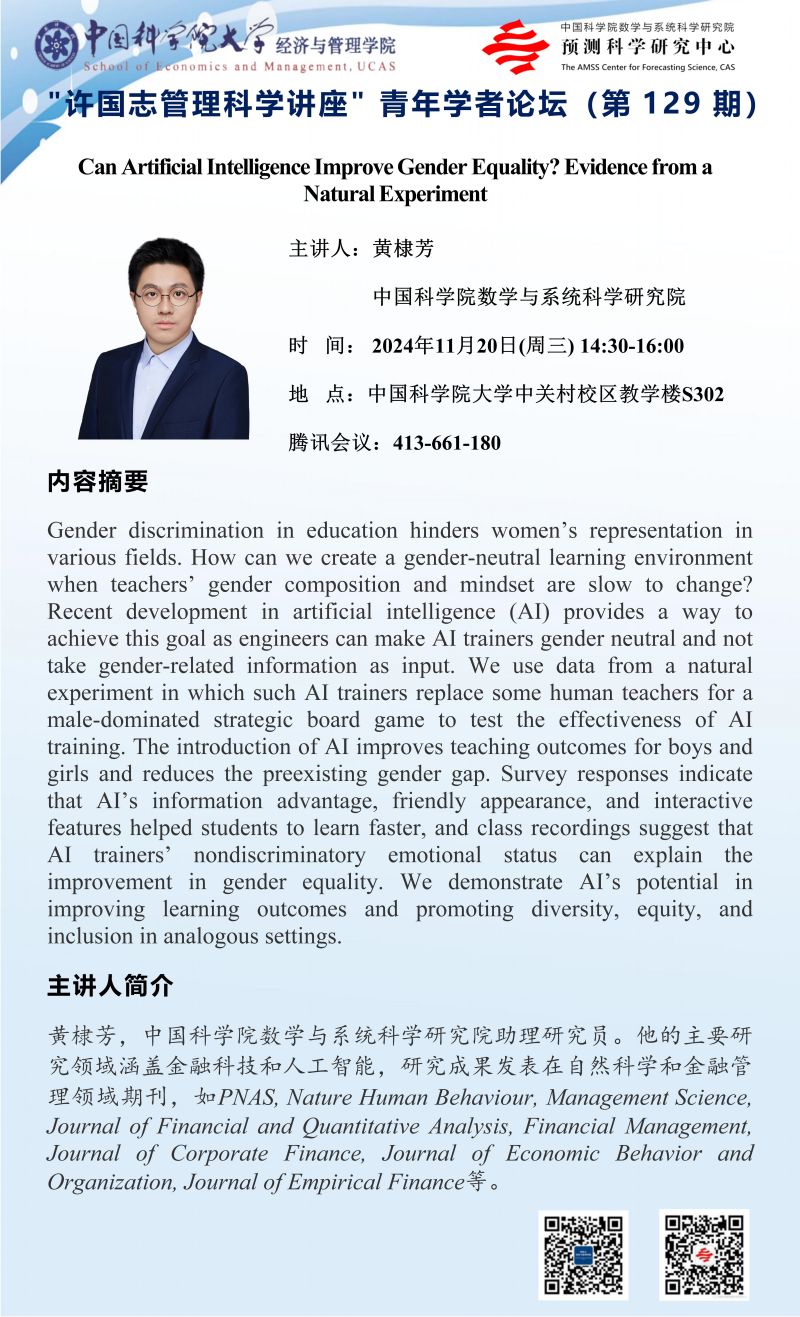
报告题目:Can Artificial Intelligence Improve Gender Equality? Evidence from a Natural Experiment
报告人:黄棣芳
中国科学院数学与系统科学研究院
报告时间:2024年11月20日(周三) 14:30-16:00
报告地点:中国科学院大学中关村校区教学楼S302
腾讯会议:413-661-180
内容摘要
Gender discrimination in education hinders women’s representation in various fields. How can we create a gender-neutral learning environment when teachers’ gender composition and mindset are slow to change? Recent development in artificial intelligence (AI) provides a way to achieve this goal as engineers can make AI trainers gender neutral and not take gender-related information as input. We use data from a natural experiment in which such AI trainers replace some human teachers for a male-dominated strategic board game to test the effectiveness of AI training. The introduction of AI improves teaching outcomes for boys and girls and reduces the preexisting gender gap. Survey responses indicate that AI’s information advantage, friendly appearance, and interactive features helped students to learn faster, and class recordings suggest that AI trainers’ nondiscriminatory emotional status can explain the improvement in gender equality. We demonstrate AI’s potential in improving learning outcomes and promoting diversity, equity, and inclusion in analogous settings.e consider a tandem queueing system in which stage 1 has one station serving multiple classes of arriving customers with different service requirements and related delay costs, and stage 2 has multiple parallel stations, with each station providing one type of service. Each station has many statistically identical servers. The objective is to design a joint capacity allocation between stages/stations and scheduling rule of different classes of customers to minimize the system’s long-run average cost. Using fluid approximation, we convert the stochastic problem into a fluid optimization problem and develop a solution procedure. Based on the solution to the fluid optimization problem, we propose a simple and easy-to-implement capacity allocation and scheduling policy and establish its asymptotic optimality for the stochastic system. The policy has an explicit index-based scheduling rule that is independent of the arrival rates, and resource allocation is determined by the priority orders established between the classes and stations. We conduct numerical experiments to validate the accuracy of the fluid approximation and demonstrate the effectiveness of our proposed policy.
主讲人简介
黄棣芳,中国科学院数学与系统科学研究院助理研究员。他的主要研究领域涵盖金融科技和人工智能,研究成果发表在自然科学和金融管理领域期刊,如PNAS, Nature Human Behaviour, Management Science, Journal of Financial and Quantitative Analysis, Financial Management, Journal of Corporate Finance, Journal of Economic Behavior and Organization, Journal of Empirical Finance等。