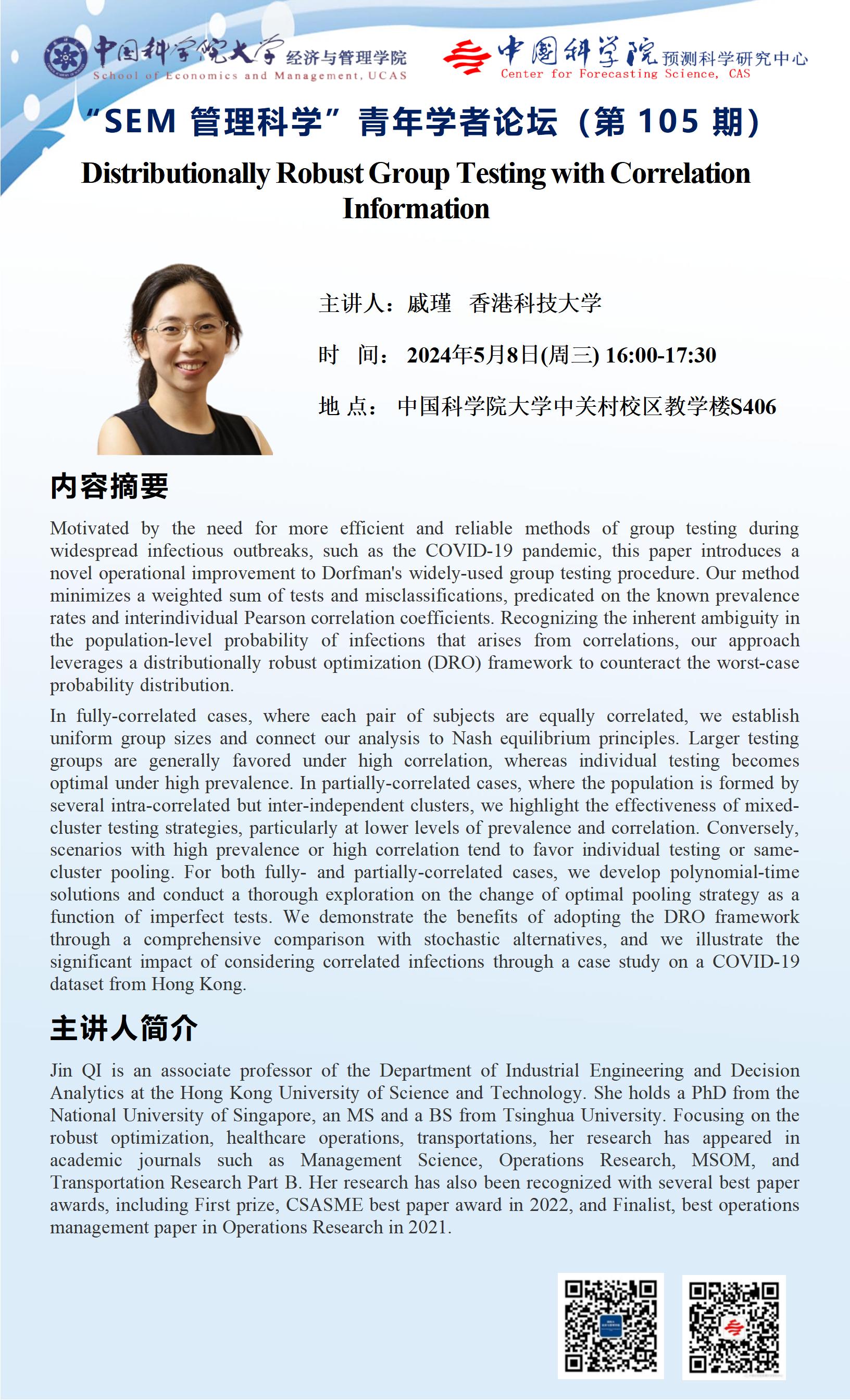
报告题目:Distributionally Robust Group Testing with Correlation Information
报 告 人: 戚瑾 香港科技大学
报告时间:2024年5月8日(周三) 16:00-17:30
报告地点:中国科学院大学中关村校区教学楼S406
内容摘要
Motivated by the need for more efficient and reliable methods of group testing during widespread infectious outbreaks, such as the COVID-19 pandemic, this paper introduces a novel operational improvement to Dorfman's widely-used group testing procedure. Our method minimizes a weighted sum of tests and misclassifications, predicated on the known prevalence rates and interindividual Pearson correlation coefficients. Recognizing the inherent ambiguity in the population-level probability of infections that arises from correlations, our approach leverages a distributionally robust optimization (DRO) framework to counteract the worst-case probability distribution.
In fully-correlated cases, where each pair of subjects are equally correlated, we establish uniform group sizes and connect our analysis to Nash equilibrium principles. Larger testing groups are generally favored under high correlation, whereas individual testing becomes optimal under high prevalence. In partially-correlated cases, where the population is formed by several intra-correlated but inter-independent clusters, we highlight the effectiveness of mixed-cluster testing strategies, particularly at lower levels of prevalence and correlation. Conversely, scenarios with high prevalence or high correlation tend to favor individual testing or same-cluster pooling. For both fully- and partially-correlated cases, we develop polynomial-time solutions and conduct a thorough exploration on the change of optimal pooling strategy as a function of imperfect tests. We demonstrate the benefits of adopting the DRO framework through a comprehensive comparison with stochastic alternatives, and we illustrate the significant impact of considering correlated infections through a case study on a COVID-19 dataset from Hong Kong.
主讲人简介
Jin QI is an associate professor of the Department of Industrial Engineering and Decision Analytics at the Hong Kong University of Science and Technology. She holds a PhD from the National University of Singapore, an MS and a BS from Tsinghua University. Focusing on the robust optimization, healthcare operations, transportations, her research has appeared in academic journals such as Management Science, Operations Research, MSOM, and Transportation Research Part B. Her research has also been recognized with several best paper awards, including First prize, CSASME best paper award in 2022, and Finalist, best operations management paper in Operations Research in 2021.
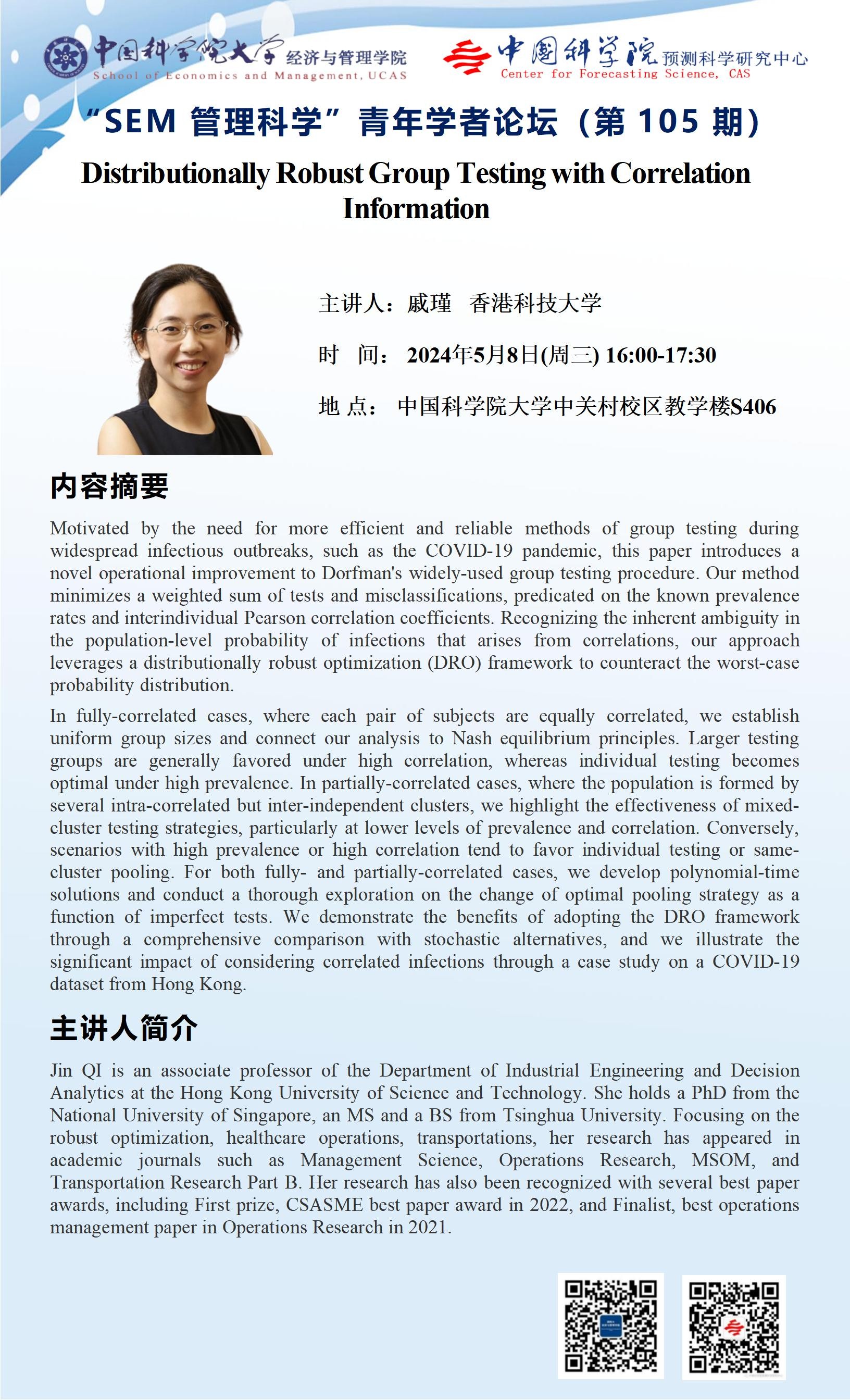
报告题目:Distributionally Robust Group Testing with Correlation Information
报 告 人: 戚瑾 香港科技大学
报告时间:2024年5月8日(周三) 16:00-17:30
报告地点:中国科学院大学中关村校区教学楼S406
内容摘要
Motivated by the need for more efficient and reliable methods of group testing during widespread infectious outbreaks, such as the COVID-19 pandemic, this paper introduces a novel operational improvement to Dorfman's widely-used group testing procedure. Our method minimizes a weighted sum of tests and misclassifications, predicated on the known prevalence rates and interindividual Pearson correlation coefficients. Recognizing the inherent ambiguity in the population-level probability of infections that arises from correlations, our approach leverages a distributionally robust optimization (DRO) framework to counteract the worst-case probability distribution.
In fully-correlated cases, where each pair of subjects are equally correlated, we establish uniform group sizes and connect our analysis to Nash equilibrium principles. Larger testing groups are generally favored under high correlation, whereas individual testing becomes optimal under high prevalence. In partially-correlated cases, where the population is formed by several intra-correlated but inter-independent clusters, we highlight the effectiveness of mixed-cluster testing strategies, particularly at lower levels of prevalence and correlation. Conversely, scenarios with high prevalence or high correlation tend to favor individual testing or same-cluster pooling. For both fully- and partially-correlated cases, we develop polynomial-time solutions and conduct a thorough exploration on the change of optimal pooling strategy as a function of imperfect tests. We demonstrate the benefits of adopting the DRO framework through a comprehensive comparison with stochastic alternatives, and we illustrate the significant impact of considering correlated infections through a case study on a COVID-19 dataset from Hong Kong.
主讲人简介
Jin QI is an associate professor of the Department of Industrial Engineering and Decision Analytics at the Hong Kong University of Science and Technology. She holds a PhD from the National University of Singapore, an MS and a BS from Tsinghua University. Focusing on the robust optimization, healthcare operations, transportations, her research has appeared in academic journals such as Management Science, Operations Research, MSOM, and Transportation Research Part B. Her research has also been recognized with several best paper awards, including First prize, CSASME best paper award in 2022, and Finalist, best operations management paper in Operations Research in 2021.