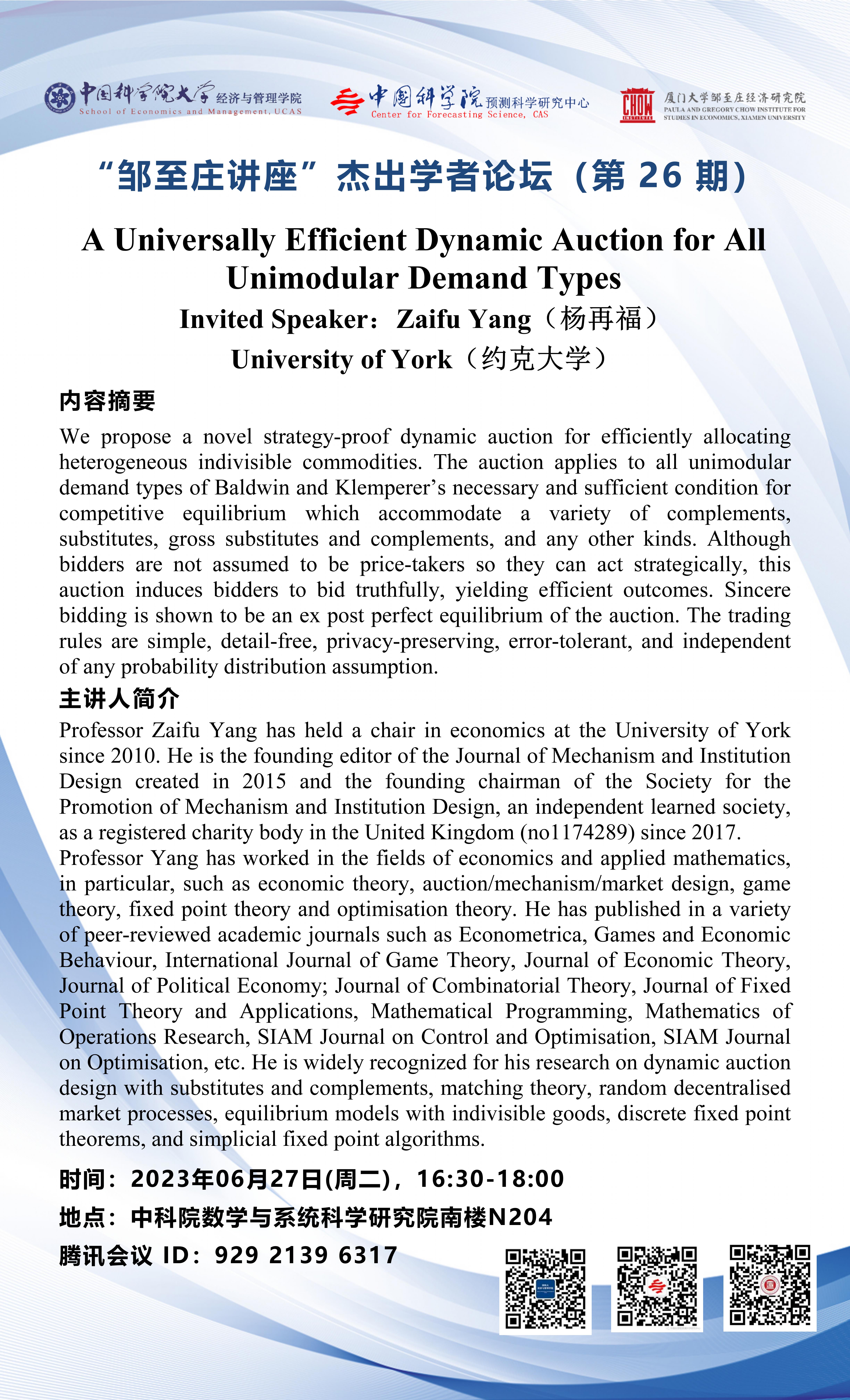
报告题目:A Universally Efficient Dynamic Auction for All Unimodular Demand Types
报 告 人:杨再福 约克大学
报告时间:2023年6月27日(周二),16:30-18:00
报告地点:中科院数学与系统科学研究院南楼N204
腾讯会议ID:929 2139 6317
内容摘要
We propose a novel strategy-proof dynamic auction for efficiently allocating heterogeneous indivisible commodities. The auction applies to all unimodular demand types of Baldwin and Klemperer’s necessary and sufficient condition for competitive equilibrium which accommodate a variety of complements, substitutes, gross substitutes and complements, and any other kinds. Although bidders are not assumed to be price-takers so they can act strategically, this auction induces bidders to bid truthfully, yielding efficient outcomes. Sincere bidding is shown to be an ex post perfect equilibrium of the auction. The trading rules are simple, detail-free, privacy-preserving, error-tolerant, and independent of any probability distribution assumption.
主讲人简介
Professor Zaifu Yang has held a chair in economics at the University of York since 2010. He is the founding editor of the Journal of Mechanism and Institution Design created in 2015 and the founding chairman of the Society for the Promotion of Mechanism and Institution Design, an independent learned society, as a registered charity body in the United Kingdom (no1174289) since 2017.
Professor Yang has worked in the fields of economics and applied mathematics, in particular, such as economic theory, auction/mechanism/market design, game theory, fixed point theory and optimisation theory. He has published in a variety of peer-reviewed academic journals such as Econometrica, Games and Economic Behaviour, International Journal of Game Theory, Journal of Economic Theory, Journal of Political Economy; Journal of Combinatorial Theory, Journal of Fixed Point Theory and Applications, Mathematical Programming, Mathematics of Operations Research, SIAM Journal on Control and Optimisation, SIAM Journal on Optimisation, etc. He is widely recognized for his research on dynamic auction design with substitutes and complements, matching theory, random decentralised market processes, equilibrium models with indivisible goods, discrete fixed point theorems, and simplicial fixed point algorithms.